What are good acoustics?
Acoustics are an important factor in our everyday life, even when we do not notice them. Let us take a closer look to what acoustics are, their importance, and how we can create good and suitable acoustics.
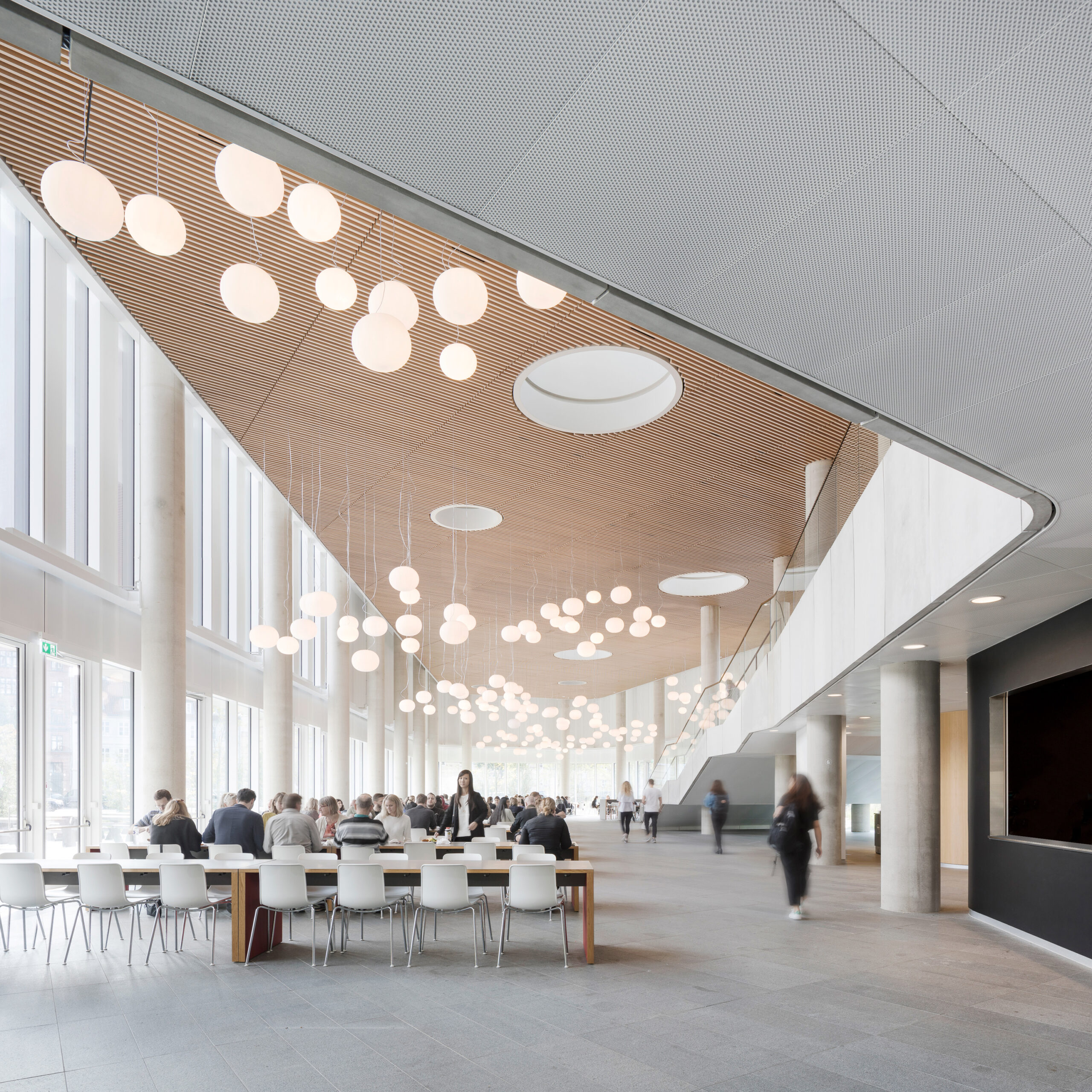
Good Acoustics Equals Accustomed Acoustics
Acoustics are an important factor in our everyday life, even when we do not notice. Are the acoustics bad in e.g., the workplace, we get less effective, we cannot concentrate and in the meeting room we miss out on the important details. We have different needs for acoustics depending on what function the room has. Therefore, it is important, that the acoustics are suitable to the room’s function and use. There is a big difference in the experienced acoustic reality depending on if you stand in a classroom or in a living room.The Sound
Acoustics are an expression for, how sound moves and reflects in a room. Sound consists of pressure waves which move across the air. Good acoustics are characterized by how quickly the pressure waves abeyance. The pressure waves are calmed by the help of sound absorbing materials. When we have a room only consisting of hard surfaces, as brick walls and concrete floor, the soundwaves will be thrown around in the room for a long time before settling. When that happens, we talk about a long reverberation time, also known as echo.Reverberation Time
Theoretical speaking, when we talk about good or bad acoustics, we look at the reverberation time. The reverberation time is decided by how many seconds it takes for the sound to fall with 60 dB after the sound source has stopped. For example, if you are talking with a person in a room with long reverberation time, the first spoken words will not die out before the next words come. It will therefore be hard to have a conversation. However, are there enough absorbing materials in the room to create optimal acoustics, we will get a good speech comprehension.Sound absorbing materials
To regulate and lower the reverberation time we need elements, which can absorb sound, so that it does not reflect in the room. The ability of elements to absorb sound is denoted by the absorption coefficient and is indicated by Alpha (a). As a starting point, it is desired that the sound absorbing elements have an Alpha value as close to 1 as possible, since the value 1 means that all sound sent towards the element is absorbed. The closer to 1 the alpha value for a sound absorbing element is, the fewer elements are needed in the room. It is important to create synergy between the function of the room and the sound absorbing elements. For example, acoustic ceilings cover a large area, which is why many elements with a low alpha value can be ideal, to secure that the reverberation time does not become too low.Examples on Sound Absorbing Materials
Sound absorbing materials can be thought into a room in various ways. You can use both the vertical and horizontal surfaces to create suitable and optimal acoustic.Acoustic Ceilings
The ceiling is often ideal to use as a sound absorbing element, as there is a large disposable surface, where sound absorbing materials can be added. Read more about DAMPA’s acoustic metal ceilings here.Acoustic Panels on the Wall
In many cases an acoustic ceiling is ideal, but when we have a room with high ceiling, the sound absorbing material will be far from the sound source. In those cases, it is more efficient to add sound absorbing materials to the walls, while these will be closest. As a rule of thumb, the walls should be covered with absorbing materials equivalent to approximately 10-20 % of the floor area. For example, if you have a floor area on 100 m2 you need 10-20 m2 absorbing materials on the walls to secure optimal acoustics. Furthermore, the acoustic panels are a quick, easy, and accessible way to optimize the acoustics in any room. Read more about DAMPA’s acoustic panels, Silent Board, here.Interior Design
Curtains, carpets, and upholstered furniture along with other interiors can also help reduce the reverberation time. However, this will rarely be enough to achieve optimal acoustics, but will act as a supplement to walls and ceiling.Get Knowledgeable Advice
When you need to improve the acoustics in a room, there are many parameters to take into consideration. It is therefore important that you get expert advice from professionals to ensure, that the solution you choose, will solve your acoustic needs, so you do not end up with the wrong placement or too many sound absorbing elements. Furthermore, it is important to ensure that the selected sound absorbing materials work as intended, choose thoroughly tested elements with the right documentation. You are always welcome to contact us by email dampa@dampa.dk or telephone +45 63 76 13 00 for a non-binding talk about solutions for your acoustic needs.Take Aways from the Article
- We have different acoustic needs depending on which room we are in
- The reverberation time is an expression for, how quick the sound fall with 60 dB
- To lower the reverberation time, we need to have acoustic elements in the room. Their ability to absorb sound is denoted by the absorption coefficient (alpha). The closer the alpha is to 1, the better the element is at absorbing the sound.
- Examples of sound-absorbing material: acoustic ceilings, acoustic wall panels and interior elements such as curtains, carpets and upholstered furniture.
- The rule of thumb says that if you use acoustic wall panels, the walls must be covered corresponding to 20% of the floor area

02.12.21
Sustainability
DAMPA Completes GCO Project
DAMPA has just completed a project within Green Circular Transition.
27.09.21
Acoustic - Design - Design - Indoor environment
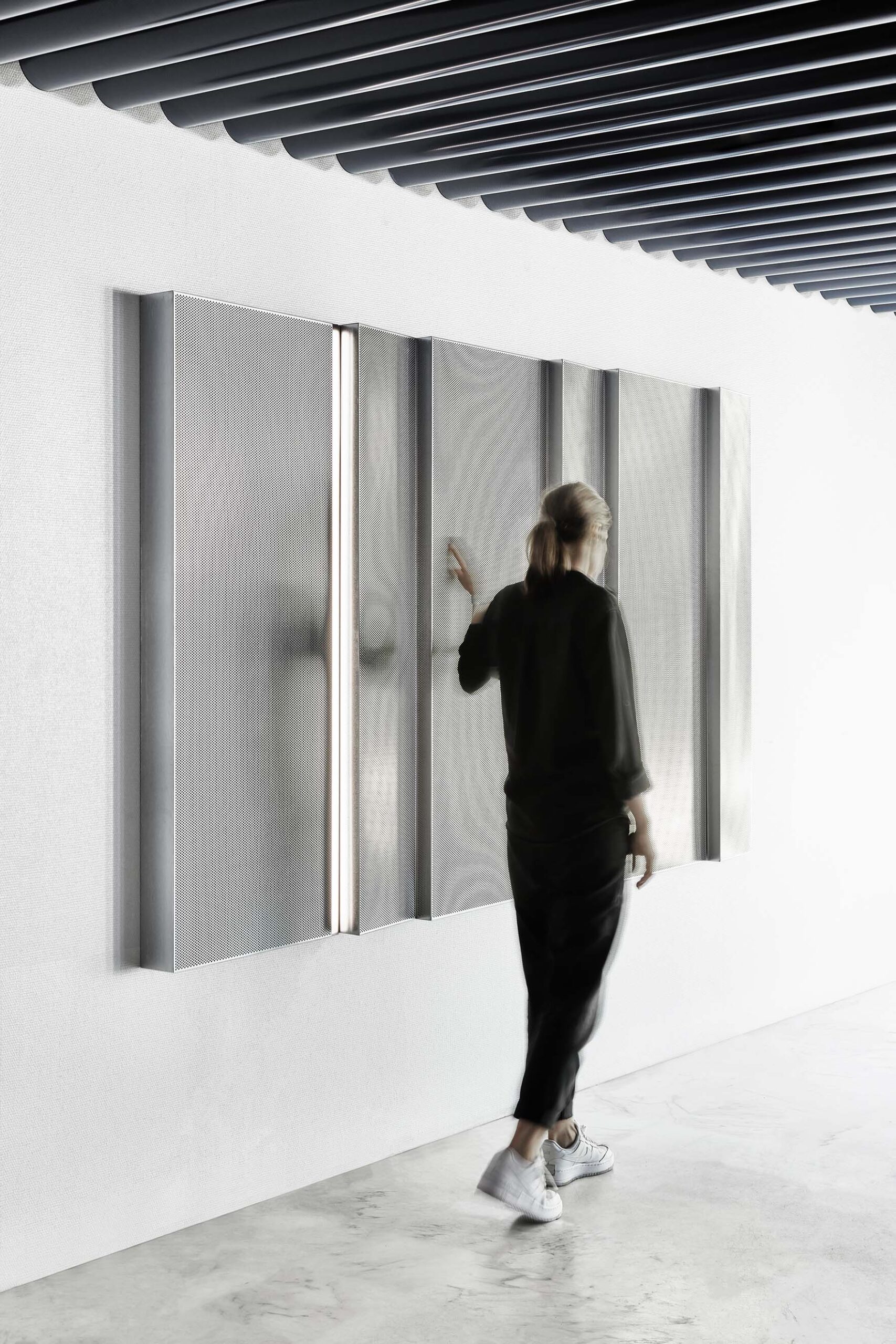
DAMPA presents a new line of wall panels
DAMPA celebrated their 70 years anniversary by launching a new line of their robust and beautiful wall panels: DAMPA® Silent Board Flex. The new wall panels are playing with the experience of sound, shapes, light and shadow.

14.11.21
Acoustic - Design - Design - Indoor environment
DOTs of Light for Life – a new Acoustic Ceiling- and Light System
Introducing DOT - a modular light and ceiling system that enhances people’s well-being.